Gaming Soundbar Industrial Design Guide: Materials, Grilles, Controls & Desktop Ergonomics
Gaming Soundbar Industrial Design Guide: Materials, Grilles, Controls & Desktop Ergonomics
Introduction
A successful gaming soundbar must do more than sound good.
It also needs to fit naturally into a modern gaming setup.
Unlike traditional speakers placed on both sides of a monitor, a gaming soundbar usually occupies one of the most valuable areas on the desk:
directly underneath the display.
This creates a unique industrial design challenge.
The product must balance:
Compact dimensions
Acoustic performance
Gaming aesthetics
RGB lighting
Easy controls
Cable management
Manufacturing feasibility
Cost
For gaming brands developing OEM or ODM soundbars, industrial design is therefore not simply about creating an attractive enclosure.
It determines how the product looks, feels, sounds, and functions in the user's real environment.
This guide explains the major industrial design considerations behind gaming soundbars.
Why Industrial Design Matters in Gaming Soundbars
Gaming products are highly visual.
Consumers often build complete setups around coordinated:
Monitors
Keyboards
Mice
PC cases
Headsets
Speakers
Lighting
A gaming soundbar sits at the center of this environment.
Its industrial design can influence:
Brand perception
Desk compatibility
User experience
Acoustic performance
Product cost
The strongest designs combine visual identity with practical engineering.
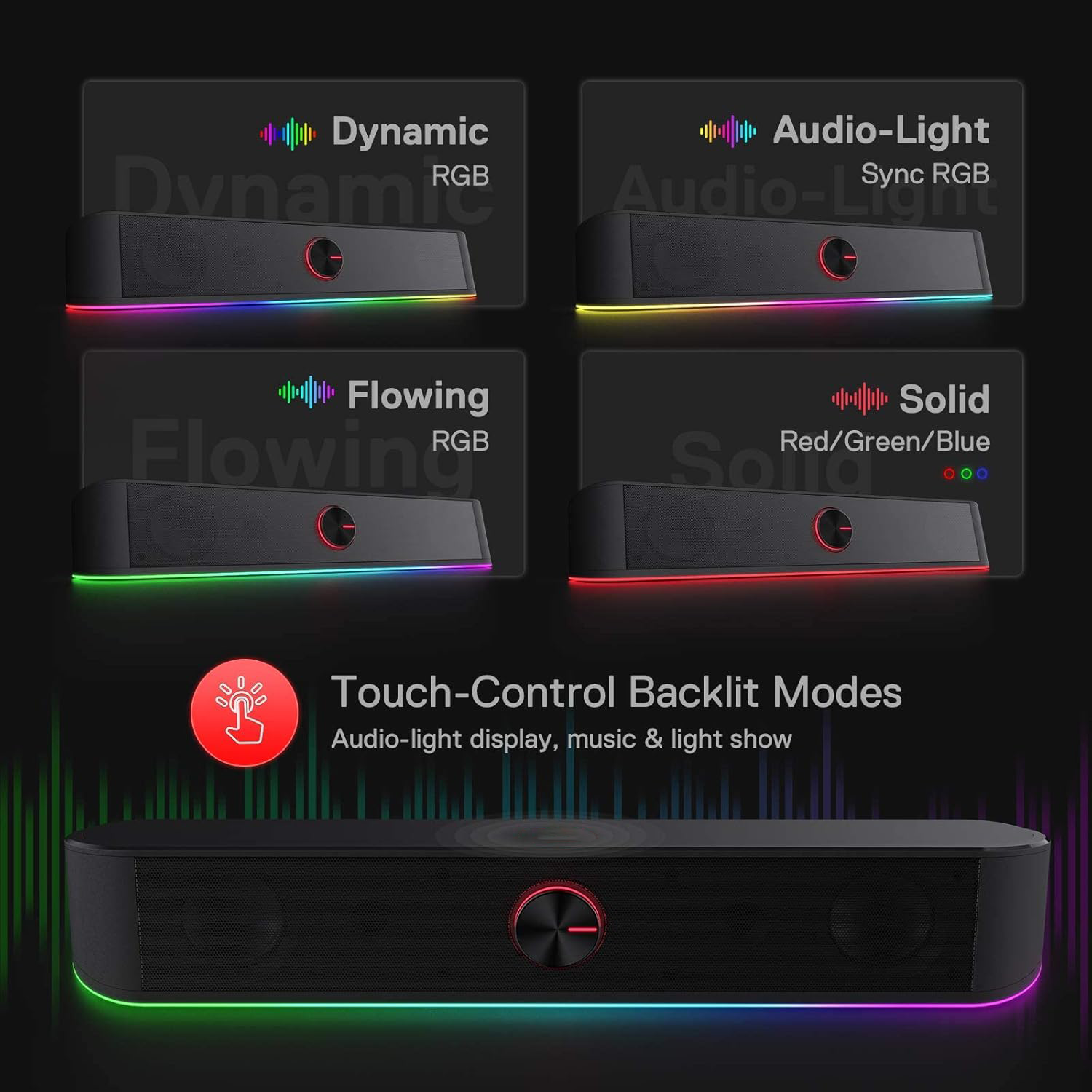
1. Start With the Gaming Desk
One of the most important principles in soundbar design is simple:
Design for the environment where the product will actually be used.
For gaming soundbars, that environment is usually the desktop.
Engineers and designers should consider:
Monitor width
Monitor stand shape
Keyboard position
User viewing distance
Desk depth
Other gaming accessories
A product can look excellent in a rendering but become inconvenient when placed underneath a real monitor.
2. Soundbar Width
Width affects both appearance and acoustic architecture.
A wider enclosure can provide:
Greater physical distance between left and right drivers
More internal component space
Strong visual presence
But excessive width can create compatibility problems with smaller desks.
A narrower design may be:
Easier to place
Easier to package
More suitable for compact setups
but offers less internal space.
The correct width depends on the target customer and monitor category.
3. Soundbar Height
Height is particularly important because the product may sit underneath a monitor.
If the enclosure is too tall, it may:
Block part of the screen
Interfere with monitor controls
Conflict with low monitor stands
A lower profile improves compatibility but can restrict:
Driver diameter
Acoustic chamber volume
PCB placement
This creates an important engineering balance:
Low Profile ↔ Acoustic Performance
4. Soundbar Depth
Depth affects:
Internal volume
Driver installation
Stability
Desk footprint
A deeper enclosure can provide more acoustic space but consumes more of the desk.
For gaming users with large keyboards and limited desk depth, this can become important.
5. Monitor Stand Compatibility
Modern monitors use many different stand designs.
Examples include:
Central stands
V-shaped feet
Wide dual feet
Monitor arms
The soundbar should be evaluated with multiple configurations.
Designers may need to consider:
Feet placement
Enclosure height
Cable exits
Control accessibility
This is an area where real-world prototype testing is particularly valuable.
6. Enclosure Materials
Gaming soundbars may use different materials depending on:
Target price
Appearance
Structural requirements
Acoustic goals
Common solutions include engineered plastics, metal grilles, and combinations of multiple materials.
Plastic Enclosures
Engineered plastic is widely used in consumer audio products.
Advantages can include:
Design flexibility
Complex shapes
Efficient mass production
Surface finishing options
Integration of structural features
Plastic housings can support gaming design elements such as:
Angular geometry
RGB windows
Decorative textures
Integrated controls
However, structural rigidity must be carefully considered.
Metal Components
Metal may be used for:
Speaker grilles
Decorative panels
Structural elements
It can contribute to:
Premium appearance
Durability
Different surface textures
However, metal components may also influence:
Cost
Weight
Tooling
Wireless design
Material selection should therefore be made together with the engineering team.
7. Speaker Grille Design
The grille is one of the most visible parts of a soundbar.
But it also has an acoustic function.
It protects the drivers while allowing sound to pass through.
Common approaches include:
Perforated metal
Acoustic fabric
Molded grille structures
Each creates a different visual identity.
Metal Grille
A perforated metal grille can provide:
Clean appearance
Strong protection
Premium feel
Designers can customize:
Hole pattern
Hole size
Shape
Finish
However, acoustic open area must be considered.
A visually dense grille may restrict sound if not properly engineered.
Fabric Grille
Fabric can create a softer and more lifestyle-oriented appearance.
It may work well for products positioned between:
Gaming
Desktop
Home entertainment
However, brands should evaluate:
Durability
Cleaning
Color consistency
Acoustic transparency
8. Grille and RGB Integration
The grille can also become part of the lighting design.
RGB may appear:
Behind the grille
Under the enclosure
Around grille edges
If LEDs are positioned behind a perforated grille, designers need to consider:
LED hotspots
Light diffusion
Hole pattern
Viewing angle
Industrial design, optical design, and acoustic engineering should work together.
9. Surface Finish
Surface treatment has a major impact on perceived quality.
Possible finishes include:
Matte
Textured
Gloss accents
Metallic appearance
Soft-touch-style surfaces where appropriate
For gaming products, matte and textured finishes are often attractive because they can reduce visible fingerprints and reflections.
The correct finish depends on the intended brand identity.
10. Gaming Design Language
Not every gaming product needs aggressive styling.
There are several possible design directions.
Esports Style
May include:
Sharp geometry
Strong RGB
High visual contrast
Technical details
Mainstream Gaming
May combine:
Moderate RGB
Clean geometry
Broad consumer appeal
Premium Minimalist Gaming
May use:
Subtle lighting
Simple surfaces
Refined materials
Fewer decorative elements
Brands should define their design language before product development begins.
11. Control Layout
Controls should be easy to reach while the user is sitting at the desk.
Possible locations include:
Top panel
Front panel
Side panel
Typical controls may include:
Power
Volume
Input selection
Bluetooth pairing
RGB control
The best layout depends on how the soundbar is positioned.
12. Volume Knob Design
A physical volume knob can be particularly attractive on gaming soundbars.
Benefits include:
Fast adjustment
Intuitive operation
Strong tactile interaction
Brands can customize:
Knob diameter
Surface texture
Rotation feel
RGB illumination
Material appearance
A well-designed knob can become a recognizable visual feature.
13. Button Design
Buttons may use:
Mechanical switches
Tactile structures
Touch controls
Each creates a different user experience.
Important considerations include:
Feedback
Durability
Accessibility
Accidental activation
Manufacturing consistency
For gaming applications, users often benefit from controls that can be operated without looking away from the monitor.
14. Control Symbols and Indicators
Users should quickly understand what each control does.
Common symbols may represent:
Power
Bluetooth
Volume
Input
Lighting
Indicators can show:
Current input
Pairing status
Power status
Good interface design reduces the need for users to repeatedly check the manual.
15. Desktop Ergonomics
Ergonomics is not only about chairs and keyboards.
Audio products also interact with the user's physical environment.
A gaming soundbar should consider:
Reach distance
Viewing angle
Control visibility
Cable position
Speaker direction
Small improvements can significantly affect daily use.
16. Driver Angle
Drivers do not always need to face directly forward.
Depending on the enclosure and desktop position, engineers may evaluate different orientations.
The goal is to direct sound appropriately toward the listener.
This must be coordinated with:
Grille design
Internal chamber
Product height
Listening distance
Industrial design should therefore not determine the driver angle independently from acoustic engineering.
17. Product Feet and Stability
A soundbar should remain stable when users:
Turn the volume knob
Press buttons
Connect cables
Feet can help:
Prevent sliding
Reduce vibration transfer
Protect the desk surface
Their location and material should be considered during mechanical development.
18. Vibration Control
Gaming soundbars can generate significant vibration at higher volumes.
Poor mechanical design may create:
Cabinet buzzing
Grille vibration
Button rattling
Movement on the desk
Engineers may address this through:
Structural reinforcement
Better assembly
Damping
Appropriate feet
Mechanical quality directly influences perceived audio quality.
19. Cable Management
A clean gaming setup is one of the main reasons users may choose a soundbar.
Poor cable design can undermine this advantage.
Designers should consider:
Cable exit direction
Port location
Cable visibility
Monitor stand interference
Ports may be positioned on:
Rear
Side
Recessed areas
The best solution depends on the target setup.
20. Rear Port Design
Rear ports can create a cleaner front appearance.
Possible interfaces may include:
USB
AUX
Power input
Other product-specific connections
However, sufficient clearance should be maintained for connectors and cables.
A port placed directly behind a large monitor stand may be difficult to access.
21. RGB and Ergonomics
RGB should enhance the environment without reducing usability.
For example:
Bottom lighting can create ambient desk illumination.
Front lighting can provide stronger visual impact.
Control-area lighting can help users locate important functions.
The design team should consider where users actually look during gaming.
22. Branding and Logo Placement
Logo placement influences both visibility and aesthetics.
Possible locations include:
Front grille
Top panel
Side panel
RGB zone
Brands should avoid placing logos where they interfere with:
Acoustic openings
Controls
Lighting diffusion
A logo can also be:
Printed
Molded
Laser marked
Backlit
depending on materials and product architecture.
23. Designing for OEM Customization
A good OEM platform should allow brands to create meaningful differentiation.
Possible customization includes:
Housing
Shape
Dimensions
Surface texture
Grille
Pattern
Material
Finish
Controls
Button layout
Knob design
Icons
RGB
Location
Effects
Diffusion
Branding
Logo
Brand colors
Packaging
The deeper the customization, the more engineering and tooling may be required.
24. Designing for ODM Flexibility
ODM projects typically begin with an existing platform.
Brands may still customize elements such as:
Logo
Housing color
RGB behavior
Surface details
Packaging
This approach can provide faster market entry while still creating a recognizable branded product.
25. Design for Manufacturing
An attractive concept must also be practical to produce.
Manufacturing engineers evaluate:
Part count
Assembly sequence
Screw locations
Snap-fit structures
Cable routing
Tolerance
Tooling feasibility
A design that is unnecessarily complex can increase:
Production time
Defect risk
Cost
Good industrial design considers mass production from the beginning.
26. Design for Assembly
The internal architecture should allow workers to assemble the product consistently.
Components may include:
Drivers
PCB
RGB modules
Controls
Grille
Wiring
Housing
Assembly design affects:
Production efficiency
Repairability
Quality consistency
27. Tooling Considerations
A fully customized soundbar enclosure may require new tooling.
Tooling decisions depend on:
Product dimensions
Housing structure
Surface requirements
Production quantity
Before opening molds, brands should carefully review:
Appearance
Mechanical structure
Port positions
Button positions
Internal layout
Changes become more expensive after tooling begins.
28. Packaging and Industrial Design
Industrial design also affects packaging.
A longer or deeper soundbar may require:
Larger retail boxes
More protective materials
Higher shipping volume
Therefore:
Product Dimensions → Packaging Dimensions → Logistics Cost
This is especially important for e-commerce products.
Reducing unnecessary enclosure size can sometimes improve both product usability and logistics efficiency.
29. E-Commerce Considerations
For brands selling online, industrial design needs to work in product images as well as in real life.
Distinctive visual elements can help communicate:
Gaming identity
RGB capability
Controls
Materials
However, the physical product must still deliver the experience promised by the images.
Design should never become purely cosmetic.
30. Common Gaming Soundbar Design Mistakes
Mistake 1: Making the Product Too Tall
This can interfere with monitor placement.
Mistake 2: Prioritizing Appearance Over Acoustics
A beautiful enclosure cannot compensate for poor acoustic architecture.
Mistake 3: Adding Controls in Inconvenient Locations
Users should not need to reach behind the monitor for everyday functions.
Mistake 4: Ignoring Cable Direction
Poor port placement creates messy setups.
Mistake 5: Overusing RGB
Lighting should support the design, not overwhelm it.
Mistake 6: Designing Without Real Monitor Testing
CAD models alone cannot represent every desktop environment.
🏭 Real Factory Insight
One of the most valuable steps during soundbar development is surprisingly simple:
Put the prototype on a real gaming desk.
Use a real:
Monitor
Keyboard
Mouse
PC
Microphone
Then ask:
Is the soundbar too tall?
Can I reach the volume knob?
Do cables interfere with the monitor stand?
Is the RGB visible at the correct angle?
Does the grille vibrate at high volume?
Does the product leave enough keyboard space?
These questions can reveal issues that are difficult to identify from drawings alone.
The best industrial design is not merely attractive in a rendering.
It works naturally in the user's environment.
How Brands Should Evaluate a Soundbar Prototype
When reviewing an OEM sample, evaluate four areas.
Appearance
Check:
Proportions
Surface finish
Grille quality
Logo
RGB integration
Ergonomics
Check:
Control access
Button feedback
Knob operation
Indicator visibility
Desktop Compatibility
Test:
Different monitor stands
Desk sizes
Cable layouts
Mechanical Quality
Check:
Stability
Gaps
Rattling
Grille vibration
Assembly consistency
Buyer Decision Checklist
Before starting a custom gaming soundbar design, define:
Target user
Target monitor size
Maximum product width
Maximum product height
Maximum product depth
Driver requirements
Grille material
Housing material
Surface finish
Control layout
Volume knob requirements
RGB location
Port locations
Branding requirements
Packaging limitations
Target retail price
Target market
These requirements give industrial designers and engineers a much stronger starting point.
Why Choose Shinedee
Shenzhen Shinedee Electronics develops gaming and desktop audio products for global brands.
Our capabilities include:
Gaming soundbar industrial design
Mechanical engineering
Acoustic development
Speaker grille design
RGB integration
USB audio solutions
Bluetooth integration
Control and user-interface development
OEM and ODM customization
Prototype development
Quality control
Mass production
Our product categories include:
Gaming Soundbars
RGB Gaming Speakers
Desktop Speakers
Portable Bluetooth Speakers
Outdoor Waterproof Speakers
With over 15 years of manufacturing experience, Shinedee supports brands from initial product concepts and industrial design through acoustic engineering, prototyping, testing, tooling, and mass production.
Frequently Asked Questions
What is the best size for a gaming soundbar?
There is no universal best size. Dimensions should be selected according to target monitor setups, desk space, driver configuration, acoustic requirements, and product positioning.
What materials are commonly used for gaming soundbars?
Depending on the product, manufacturers may use engineered plastics, metal grilles, fabric, decorative components, or combinations of different materials.
Is a metal grille better than a fabric grille?
Neither is automatically better. Metal can provide strong protection and a technical appearance, while fabric can create a softer aesthetic. Acoustic transparency and target positioning should also be considered.
Where should gaming soundbar controls be placed?
Controls should be easy to access when the product is underneath a monitor. Top, front, or side positions may work depending on the enclosure design.
Why are volume knobs popular on gaming soundbars?
They provide fast, intuitive volume adjustment and can also become a distinctive industrial design feature.
Can gaming soundbar housing be fully customized?
Yes. Full OEM projects can potentially customize dimensions, structure, grille, controls, materials, RGB integration, and other design elements. New tooling may be required.
Can an ODM soundbar still have custom branding?
Yes. Depending on the existing platform, ODM customization may include logos, colors, RGB settings, surface details, and packaging.
Does soundbar size affect shipping cost?
Yes. Product dimensions influence packaging volume, which can affect storage and transportation costs.
Conclusion
Industrial design plays a central role in gaming soundbar development.
The product must fit underneath a monitor, provide accessible controls, integrate RGB lighting, support acoustic performance, and remain practical to manufacture.
Successful design therefore requires coordination between:
Industrial design
Acoustic engineering
Mechanical engineering
Electronics
RGB development
Manufacturing engineering
For gaming brands, the goal should not simply be creating the most aggressive-looking soundbar.
The goal is creating a product that feels naturally designed for the gaming desk.
By considering materials, dimensions, grilles, controls, ergonomics, cables, acoustics, and manufacturing from the beginning, brands can develop gaming soundbars that combine visual differentiation with practical everyday usability.
Shinedee supports global brands with OEM and ODM gaming soundbar development from industrial design and acoustic engineering through tooling, testing, and mass production.