Portable Speaker FAQ — Features, Setup, Compatibility & Wholesale Buying Guide
This FAQ guide covers everything you need to know about Portable Speakers, including sound performance, output power, battery life, Bluetooth connectivity, setup, compatibility, troubleshooting, OEM customization, and wholesale buying advice. It is suitable for home entertainment, travel, camping, outdoor activities, and parties.
Whether you are choosing a speaker for personal use or sourcing an OEM black IPX6 water resistance bluetooth wireless portable speaker, this guide will help you understand the essential specifications, applications, connection methods, and supplier-selection considerations.
Definition & Basics
1. What is a Portable Speaker?
A Portable Speaker is a compact, battery-powered audio device designed for wireless or wired audio playback. It can usually connect to smartphones, tablets, laptops, and other compatible devices through Bluetooth.
Unlike conventional wired speakers, Portable Speakers are designed for mobility. Their built-in rechargeable batteries and compact enclosures allow users to enjoy music at home, while traveling, or during outdoor activities.
2. How does a Portable Speaker work?
A Portable Speaker receives an audio signal from a connected source device. Bluetooth models transmit the signal wirelessly, while some products also support AUX, USB, TF card, or other playback methods.
The speaker’s internal components decode and amplify the signal before sending it to the built-in drivers. A rechargeable battery supplies power when an external power source is unavailable.
3. What is the difference between portable and traditional speakers?
Portable Speakers are designed for mobility and typically include built-in batteries, Bluetooth connectivity, compact enclosures, and convenient controls.
Traditional speakers may require an external amplifier, continuous power connection, or additional audio cables. They are usually designed for fixed installation rather than frequent transportation.
4. What does wattage mean on a Portable Speaker?
Wattage indicates the speaker’s audio output power. In general, a higher-wattage Portable Speaker can produce greater volume and cover a larger listening area. However, wattage alone does not determine sound quality or perceived loudness.
Driver efficiency, enclosure design, acoustic tuning, bass performance, distortion control, and the surrounding environment also affect actual performance. When comparing products, buyers should check whether the stated figure refers to rated power or peak power.
5. What Portable Speaker wattage is suitable for different applications?
The appropriate wattage depends on the intended use, listening distance, number of people, and surrounding noise level.
Below 5W: Suitable for personal listening, bedside use, quiet offices, and small indoor spaces.
5W–10W: Suitable for bedrooms, kitchens, travel, and casual background music.
10W–20W: Suitable for home entertainment, camping, picnics, poolside use, and small gatherings.
20W–40W: Suitable for larger rooms, outdoor activities, barbecues, and small parties.
40W and above: Suitable for louder gatherings, larger outdoor spaces, and applications requiring stronger sound coverage.
These ranges are general references rather than strict rules. Outdoor environments usually require more output power because there are fewer surfaces to reflect sound and more background noise.
A well-designed lower-wattage speaker may also perform better than a poorly designed higher-wattage model. Buyers should evaluate wattage together with sound quality, battery capacity, speaker configuration, portability, and intended application.
Features
6. How long does the battery last on a Portable Speaker?
Battery life varies according to the battery capacity, volume level, lighting effects, Bluetooth connection, audio content, and other functions.
Portable Speakers may provide several hours or more of playback per charge. For accurate information, check the specified testing conditions because playback time is often measured at a moderate volume.
7. Does a Portable Speaker support Bluetooth, AUX, or USB playback?
Most modern Portable Speakers support Bluetooth. Depending on the model, additional options may include:
AUX input
USB playback
USB charging
TF or microSD card playback
TWS wireless pairing
Hands-free calling
The available functions depend on the product configuration. Buyers should distinguish between a USB port used for charging and one that supports audio playback.
8. Does a Portable Speaker provide stereo sound?
Some Portable Speakers use multiple drivers to produce left and right audio channels within one enclosure. Others may support True Wireless Stereo, commonly known as TWS, allowing two compatible speakers to operate as a stereo pair.
Stereo performance depends on the speaker configuration, driver spacing, audio source, and listening position.
9. Does a Portable Speaker have strong bass?
Many Portable Speakers use bass radiators, enhanced enclosures, or digital audio processing to improve low-frequency performance.
Bass quality depends on the size and type of the drivers, enclosure volume, passive-radiator design, amplifier power, and acoustic tuning. Output wattage alone does not guarantee strong or accurate bass.
10. Does a Portable Speaker have RGB or LED lighting?
Some Portable Speakers feature RGB or LED lighting for parties, outdoor gatherings, and visual ambience. Depending on the model, users may be able to change the colors, select lighting patterns, or turn the lights off.
Lighting effects may increase power consumption and reduce total battery playback time.
Use Cases
11. Can I use a Portable Speaker at home and outdoors?
Yes. Portable Speakers are versatile audio devices suitable for indoor and outdoor applications.
Common uses include:
Home entertainment
Music in bedrooms or kitchens
Picnics and barbecues
Camping and hiking
Beach and poolside activities
Small parties and gatherings
Travel
Office or workshop use
For outdoor use, consider battery life, water resistance, durability, carrying convenience, and required volume.
12. Is an IPX6 Portable Speaker suitable for camping?
Yes. An IPX6 Portable Speaker can be a practical choice for camping because it is designed to resist splashes and water exposure under specified conditions.
For camping applications, buyers should also consider battery capacity, charging time, product weight, carrying design, wireless range, enclosure durability, and charging-port protection.
13. Can I use a Portable Speaker at the beach or pool?
A water-resistant Portable Speaker can be used near a beach or pool if the product instructions permit it. Keep the speaker away from complete submersion and make sure all protective port covers are securely closed.
After exposure to sand, salt, or pool water, clean and dry the exterior according to the manufacturer’s instructions before charging the product.
14. Are Portable Speakers suitable for parties?
Yes. Portable Speakers can be used for small indoor parties, outdoor gatherings, barbecues, picnics, and other social events.
The appropriate model depends on the number of people, venue size, background noise, desired volume, and speaker placement. Larger spaces and louder events generally require higher output power or multiple compatible speakers.
Compatibility & Connectivity
15. Which devices can connect to a Portable Speaker?
A Bluetooth Portable Speaker may connect to compatible devices such as:
Smartphones
Tablets
Laptops
Desktop computers
Selected televisions
MP3 players
Handheld gaming devices
Other Bluetooth-enabled audio sources
Compatibility depends on the Bluetooth profiles, operating system, ports, and audio-output capabilities of the source device.
16. How do I connect my phone to a Portable Speaker?
To connect a phone through Bluetooth:
Turn on the Portable Speaker.
Select Bluetooth pairing mode.
Open the phone’s Bluetooth settings.
Search for available devices.
Select the speaker’s pairing name.
Wait for the connection confirmation.
Play audio and adjust the volume.
After the first successful connection, many speakers automatically reconnect to the most recently paired device when Bluetooth is available.
17. Can I pair two Portable Speakers together?
Some Portable Speakers support TWS or another wireless pairing function. This allows two compatible speakers to play synchronized audio and may create left and right stereo channels.
The two speakers usually need to be the same or mutually compatible models. Follow the manufacturer’s pairing instructions because the process varies by product.
18. What is the difference between Bluetooth 5.0 and Bluetooth 5.3?
Bluetooth 5.0 and Bluetooth 5.3 are different versions of the Bluetooth standard. Bluetooth 5.3 includes improvements designed to support more efficient and stable wireless communication in compatible devices.
Actual connection quality depends on both the speaker and source device, as well as distance, obstacles, antenna design, software, and surrounding wireless interference. A newer Bluetooth version alone does not guarantee better sound quality.
19. What is the normal Bluetooth range of a Portable Speaker?
The effective Bluetooth range depends on the product design and operating environment. Walls, furniture, people, metal objects, and nearby wireless equipment can reduce the connection distance.
For a stable connection, keep the source device within the manufacturer’s recommended range and avoid placing large obstacles between the device and speaker.
20. Can I answer phone calls through a Portable Speaker?
Some Portable Speakers include a built-in microphone and hands-free calling function. When connected to a smartphone, users may be able to answer or end calls through the speaker controls.
Call quality depends on microphone placement, distance, environmental noise, and Bluetooth performance. Confirm that the product includes a microphone if this feature is required.
Setup & Troubleshooting
21. How do I set up a Portable Speaker for the first time?
A typical first-time setup involves the following steps:
Fully charge the speaker if recommended.
Turn on the speaker.
Select Bluetooth or another input mode.
Connect the source device.
Play audio at a moderate volume.
Test the buttons and available functions.
Review the manual for charging and water-resistance precautions.
The specific setup process may vary by model.
22. Why can’t my device find the Bluetooth speaker?
If the speaker does not appear in the Bluetooth device list:
Confirm that the speaker is in pairing mode.
Move the source device closer.
Disconnect the speaker from previously paired devices.
Turn Bluetooth off and on again.
Restart both devices.
Remove the old pairing record and reconnect.
Check whether the speaker has reached its pairing limit.
Consult the product manual.
23. Why does the Portable Speaker keep disconnecting?
Bluetooth disconnections may be caused by excessive distance, physical obstacles, wireless interference, low battery power, or problems with the source device.
Move the devices closer, charge the speaker, reduce nearby interference, restart both devices, and pair them again.
24. What should I do if the Portable Speaker will not charge?
First, check the charging cable, adapter, power source, and charging port. Make sure the port is clean, dry, and free from damage.
Try a compatible cable or power adapter if permitted by the manual. Do not charge the speaker when the port is wet. Contact the supplier or manufacturer if the speaker still does not charge.
Buying Guide
25. How do I choose the right Portable Speaker?
Consider the following factors before buying:
Sound quality
Rated output power
Battery capacity and playback time
Bluetooth version
Wireless range
IP water-resistance rating
Product dimensions and weight
Enclosure durability
Bass performance
Charging method
TWS pairing
Hands-free calling
RGB or LED lighting
Carrying strap or handle
Intended application
Warranty and after-sales service
The best Portable Speaker should balance sound, portability, durability, connectivity, and cost.
26. Should I prioritize output power, battery life, or water resistance?
Your priority should depend on how the speaker will be used:
Choose higher output power for louder playback or larger spaces.
Choose longer battery life for travel, camping, and extended outdoor use.
Choose IPX6 water resistance for environments where rain and splashes may occur.
Choose a compact design for convenient transportation.
Choose enhanced bass for music and party applications.
Choose TWS support when two-speaker pairing is required.
Choose simple controls for easier everyday operation.
For outdoor applications, balanced sound, adequate battery life, durable construction, and water resistance are often more important than one specification alone.
27. How much should I spend on a Portable Speaker?
Portable Speaker pricing depends on output power, battery capacity, driver configuration, Bluetooth solution, enclosure materials, water-resistant design, additional functions, branding, and order quantity.
Consumers should compare specifications, warranty coverage, and intended use instead of selecting a product based only on price.
For wholesale projects, the final cost may also depend on customization, packaging, certifications, testing requirements, production quantity, and shipping arrangements.
28. What should wholesale buyers consider when sourcing Portable Speakers?
Wholesale buyers should evaluate:
Acoustic performance
Rated and maximum output power
Battery specifications
IPX6 testing requirements
Bluetooth stability
Enclosure materials
Product durability
Electronic components
Charging safety
Product certifications
Logo and packaging customization
Minimum order quantity
Sample lead time
Mass-production capacity
Quality-control procedures
Warranty and after-sales support
Buyers should request samples and verify important specifications before confirming a large order.
29. Can Portable Speakers be customized through OEM or ODM services?
Yes. Experienced manufacturers may provide OEM and ODM services for brands, wholesalers, distributors, and retailers.
Depending on the project and order quantity, customization may include:
Product color
Brand logo
Enclosure structure
Acoustic tuning
Output power
Bluetooth solution
Battery capacity
Control buttons
RGB or LED lighting
Packaging design
Accessories
Instruction manuals
Market-specific labels
Customization options, costs, lead times, and minimum order quantities depend on the project requirements.
30. What does OEM mean for Portable Speakers?
OEM refers to Original Equipment Manufacturer. In an OEM project, a factory manufactures Portable Speakers according to the customer’s branding and agreed product requirements.
An OEM black IPX6 water resistance bluetooth wireless portable speaker may include customized branding, packaging, controls, lighting effects, accessories, output power, battery capacity, or other technical configurations.
All specifications should be confirmed with the manufacturer before sampling and mass production.
31. How do I choose a reliable Portable Speaker manufacturer?
Consider the manufacturer’s industry experience, research and development capabilities, acoustic engineering, structural design, mold manufacturing, quality control, production capacity, customization services, certifications, and export experience.
A manufacturer with integrated development and production capabilities can provide better coordination throughout product design, prototyping, testing, certification, mass production, and delivery.
About Shenzhen Shinedee Electronics Co., Ltd.
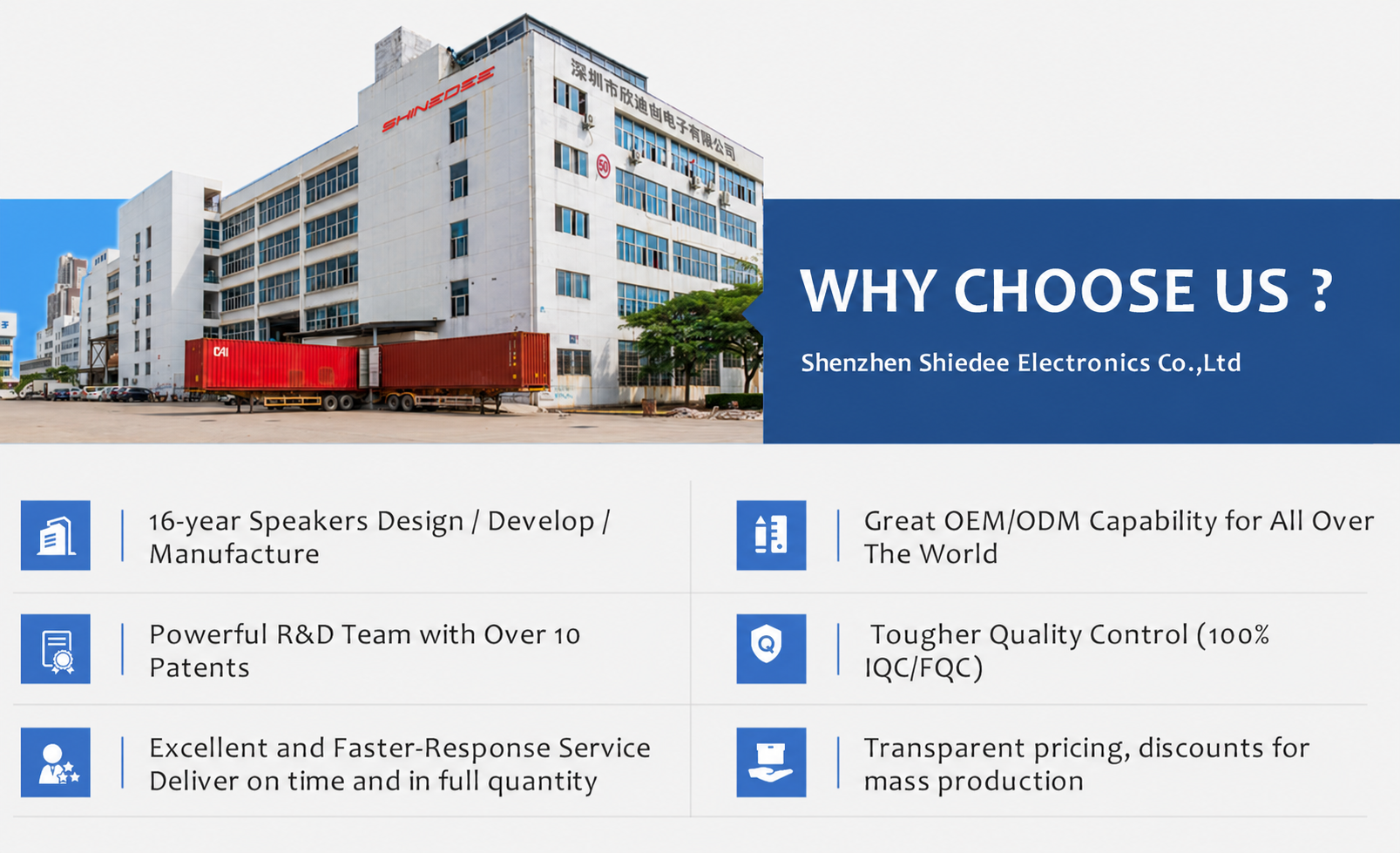
Founded in 2010, Shenzhen Shinedee Electronics Co., Ltd. is a professional audio manufacturer specializing in product research and development, production, and international sales.
The company integrates product design, structural development, mold manufacturing, and large-scale production, providing comprehensive one-stop audio manufacturing services.
Its main products include Portable speakers, RGB gaming speakers, Gaming soundbars and outdoor waterproof Bluetooth RGB speakers. By combining acoustic performance with creative lighting design, its products deliver reliable sound and an engaging visual experience for gaming entertainment, travel, parties, and outdoor activities.
Shinedee’s products are exported to Europe, the United States, South Korea, Taiwan, and other international markets. The company provides OEM and ODM audio solutions for global brands, importers, wholesalers, distributors, and retailers.
Conclusion
These FAQs cover the key aspects of Portable Speakers, including audio power, battery life, Bluetooth connectivity, device compatibility, setup, troubleshooting, OEM customization, and wholesale purchasing.
A well-designed Portable Speaker can provide dependable audio, convenient wireless playback, and practical outdoor protection in a compact enclosure. When choosing a product, compare its acoustic performance, battery specifications, water-resistance rating, connectivity, durability, dimensions, and intended application.
For customers seeking an OEM black IPX6 water resistance bluetooth wireless portable speaker, Shenzhen Shinedee Electronics Co., Ltd. provides product design, structural development, mold manufacturing, mass production, and OEM/ODM services.
With experience serving international markets, Shinedee continues to provide global customers with stable manufacturing support, innovative RGB audio products, and reliable outdoor wireless speaker solutions.
Get Instant Quote/ Send Inquiry Now!