Gaming Soundbar Manufacturer: Complete OEM & ODM Guide for Gaming Brands in 2026
Gaming Soundbar Manufacturer: Complete OEM & ODM Guide for Gaming Brands
Introduction
Gaming soundbars are becoming an increasingly important category in desktop audio.
Compared with traditional 2.0 speaker systems, a gaming soundbar offers a cleaner desktop layout, easier installation, modern RGB lighting, and compact audio performance designed for PCs, laptops, monitors, and gaming consoles.
For gaming brands, Amazon sellers, importers, distributors, and retailers, choosing the right gaming soundbar manufacturer is essential.
A capable OEM and ODM partner should provide more than basic assembly. The manufacturer should understand acoustic design, RGB integration, structural engineering, connectivity, product testing, and international market requirements.
This guide explains how gaming soundbars are developed and what brands should consider when choosing a manufacturing partner.
What Is a Gaming Soundbar?
A gaming soundbar is a compact speaker system designed primarily for desktop gaming, entertainment, streaming, and multimedia use.
It is usually placed:
Under a monitor
In front of a gaming display
On a compact desktop
Below a television or secondary screen
Typical gaming soundbar features include:
Stereo speaker drivers
RGB lighting
Bluetooth connectivity
USB audio
AUX input
Physical control buttons
Compact desktop-friendly dimensions
Unlike traditional television soundbars, gaming soundbars often focus more on desktop aesthetics, convenience, RGB effects, and close-range listening.
Why Gaming Soundbars Are Growing
1. Smaller and Cleaner Gaming Setups
Many users prefer a simple desktop layout without separate left and right speakers.
A soundbar can:
Reduce cable clutter
Save desk space
Fit under a monitor
Create a cleaner visual setup
This is particularly attractive to users with compact desks, dual-monitor systems, or minimalist gaming environments.
2. Growing Demand for RGB Gaming Accessories
RGB lighting is now common across:
Keyboards
Mice
PC cases
Monitor lights
Gaming speakers
A gaming soundbar with synchronized or adjustable RGB lighting helps complete the visual identity of a gaming setup.
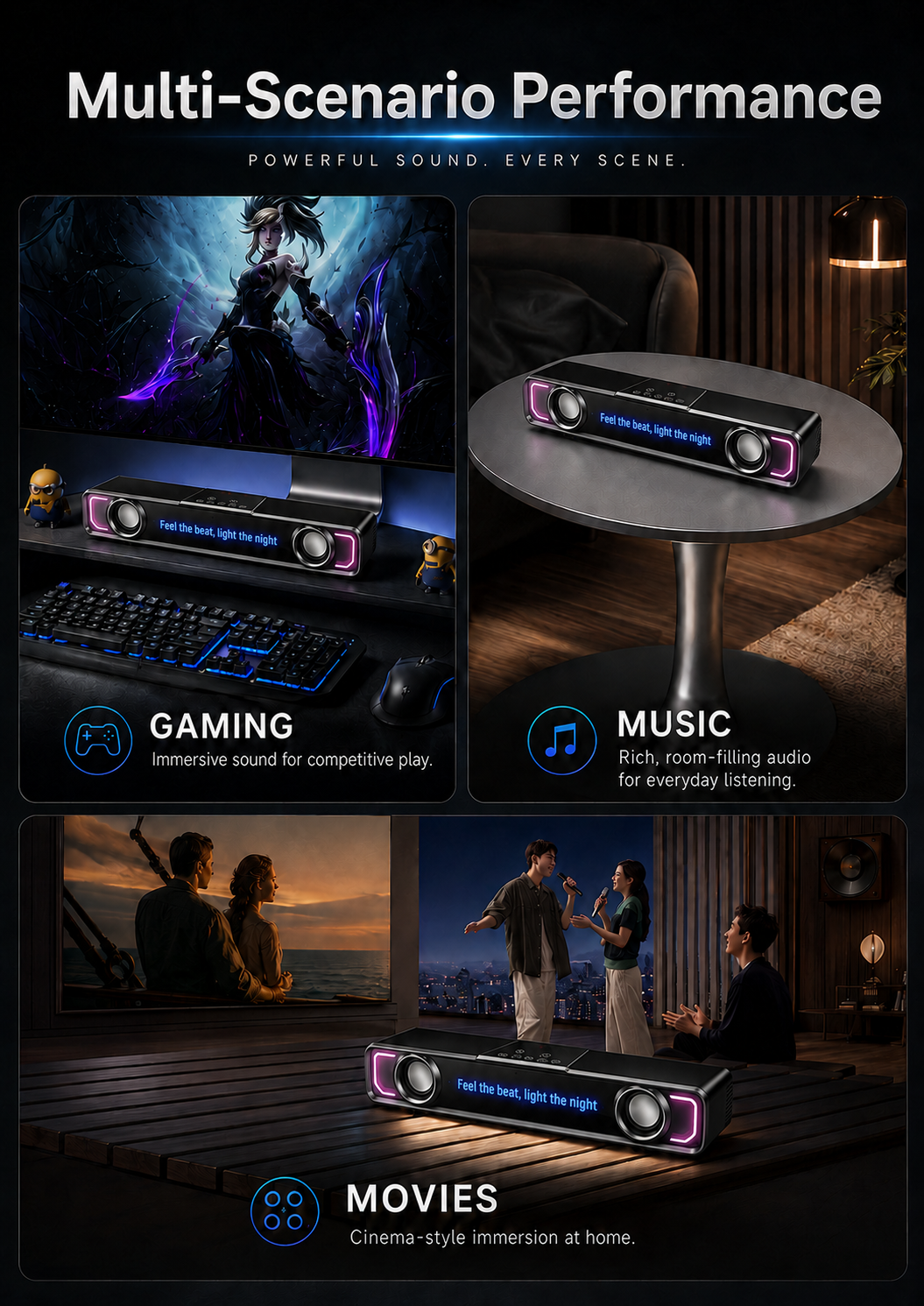
3. Multi-Purpose Usage
Gaming soundbars are not limited to games.
Consumers also use them for:
Music
Movies
Video calls
Live streaming
Online learning
General computer audio
This wider usage increases their commercial potential.
4. Strong Retail Presentation
A long, compact soundbar shape creates a modern product appearance.
Combined with RGB lighting and premium packaging, gaming soundbars can achieve strong shelf appeal in:
Electronics stores
Gaming accessory shops
Online marketplaces
Consumer electronics chains
Key Features Buyers Expect
1. Clear and Balanced Sound
Sound quality remains the foundation of the product.
Buyers typically expect:
Clear dialogue
Balanced midrange
Controlled bass
Low distortion
Stable sound at higher volume
Because gaming soundbars are used at close range, clarity and tonal balance are especially important.
2. Stereo Performance
A gaming soundbar should create a wider soundstage than a basic mono speaker.
Manufacturers can improve stereo performance through:
Driver positioning
Internal chamber separation
DSP tuning
Soundbar width
Acoustic grille design
A wider stereo image improves gaming, movie, and music experiences.
3. RGB Lighting
Common RGB options include:
Static colors
Rainbow effects
Breathing mode
Gradient transitions
Music-reactive lighting
RGB on/off control
For OEM projects, lighting modes can be adjusted to match brand identity and target pricing.
4. Flexible Connectivity
Modern gaming soundbars often support several connection methods.
Common options include:
Bluetooth
USB sound card mode
AUX input
USB power
Type-C power
Optional TF card playback
Multiple input methods allow the product to work with different devices and usage scenarios.
5. Simple Controls
Users expect quick and intuitive operation.
Typical controls include:
Power
Volume up and down
Previous and next track
Mode switching
RGB lighting control
Bluetooth pairing
Control layout should be easy to understand without creating unnecessary visual complexity.
6. Desktop-Friendly Size
Gaming soundbars should fit comfortably under common monitor sizes.
Important considerations include:
Width
Height
Depth
Cable direction
Button position
Monitor stand clearance
A soundbar that is too tall may block the screen, while one that is too deep may occupy too much desk space.
Gaming Soundbar vs 2.0 Gaming Speakers
| Factor | Gaming Soundbar | 2.0 Gaming Speakers |
|---|---|---|
| Desktop Space | Compact | Requires left and right space |
| Installation | Simple | More cable management |
| Stereo Separation | Moderate | Usually wider |
| Visual Style | Clean and integrated | More traditional gaming setup |
| Portability | Easier | Less convenient |
| Monitor Placement | Fits under monitor | Positioned beside monitor |
Neither option is universally better.
Gaming soundbars are ideal for users who value compact design and simplicity, while 2.0 speakers may appeal to users who prioritize wider physical stereo separation.
OEM Gaming Soundbar Development Process
Step 1: Define Product Positioning
The brand should first define:
Target user
Target retail price
Required output power
RGB expectations
Connectivity requirements
Packaging strategy
For example, an entry-level Amazon product may prioritize affordability and USB audio, while a premium gaming brand may require exclusive tooling, advanced DSP tuning, and custom lighting.
Step 2: Select the Product Structure
The manufacturer evaluates:
Overall size
Driver configuration
Acoustic chamber
Passive radiator options
PCB placement
Lighting position
The structure must balance sound quality, appearance, cost, and production efficiency.
Step 3: Develop the Acoustic System
Acoustic development may include:
Driver selection
Chamber optimization
Bass adjustment
Stereo balance
DSP tuning
Maximum volume testing
The goal is not simply to make the product louder, but to achieve stable and comfortable sound at desktop listening distance.
Step 4: Design the RGB System
RGB development includes:
LED placement
Light diffusion material
Lighting pattern
Controller design
Firmware behavior
Poor light diffusion may create visible bright spots, while a well-designed system produces a smooth and premium effect.
Step 5: Confirm Connectivity and Controls
The product team determines:
Bluetooth version
USB audio compatibility
AUX requirements
Power input
Button functions
Voice prompts
The final feature combination should match the target market rather than include unnecessary functions.
Step 6: Prototype and Test
Prototype evaluation should cover:
Sound quality
Bluetooth stability
USB sound card compatibility
RGB consistency
Button response
Housing quality
Cable performance
Packaging protection
Multiple revisions may be required before mass production approval.
Step 7: Pilot Production and Mass Production
Before large-scale production, a pilot run helps confirm:
Assembly process
Testing procedures
Production efficiency
Quality standards
Packaging accuracy
Once the pilot batch is approved, the project can move into mass production.
ODM Gaming Soundbar Solutions
ODM is suitable for brands that need:
Faster product launch
Lower development investment
Proven structures
Flexible branding options
Typical ODM customization includes:
Logo printing
Packaging
Product color
RGB mode adjustment
Bluetooth name
User manual
ODM can be an effective way to test market demand before investing in a fully customized model.
OEM Gaming Soundbar Solutions
OEM is more suitable for brands that require:
Exclusive appearance
Custom tooling
Unique driver configuration
Brand-specific lighting
Customized sound tuning
Long-term product differentiation
OEM requires more development time and investment, but it provides stronger control over the final product and brand experience.
Important Quality Tests
A reliable gaming soundbar manufacturer should conduct:
Audio Testing
Channel balance
Distortion
Bass response
Maximum volume
Noise inspection
Connectivity Testing
Bluetooth pairing
Reconnection
USB audio
AUX input
Device compatibility
RGB Testing
Color consistency
Lighting modes
Button control
Long-term operation
Reliability Testing
Aging tests
Button life tests
Cable bending tests
Drop and vibration tests
Packaging transportation tests
These procedures help reduce returns and protect brand reputation.
🏭 Real Factory Insight
In actual gaming soundbar projects, the biggest challenge is often fitting good acoustic performance into a slim structure.
A narrow enclosure limits internal air volume, while the long housing may create unwanted vibration or resonance if it is not properly reinforced.
For this reason, successful development requires coordination between structural engineers and acoustic engineers.
Small changes to driver position, internal chamber size, grille structure, or DSP settings can significantly improve the final sound.
RGB lighting also needs to be planned early. Adding lights after the structure is already finalized may create uneven illumination, heat issues, or unnecessary assembly complexity.
How to Choose a Gaming Soundbar Manufacturer
Brands should evaluate the following areas.
Relevant Product Experience
The supplier should have experience with:
Gaming audio
Desktop speakers
Soundbars
RGB products
Engineering Capability
Look for:
Structural design
Acoustic tuning
PCB development
RGB integration
Tooling support
Quality Management
Confirm whether the manufacturer has:
Incoming material inspection
In-process quality control
Finished product testing
Aging tests
Pre-shipment inspection
OEM and ODM Flexibility
The right partner should support both fast ODM projects and more customized OEM development.
Export Experience
The manufacturer should understand compliance and market expectations for destinations such as:
United States
South Korea
Singapore
Germany
United Kingdom
Why Choose Shinedee
Shenzhen Shinedee Electronics Co., Ltd. specializes in gaming audio and Bluetooth speaker manufacturing.
Our product categories include:
Gaming Soundbars
RGB Gaming Speakers
2.0 Computer Speakers
Portable Bluetooth Speakers
Outdoor Waterproof Speakers
Our OEM and ODM services include:
Product concept support
Industrial design
Structural engineering
Acoustic tuning
RGB customization
Prototype development
Tooling
Mass production
Quality control
With over 15 years of manufacturing experience, Shinedee helps gaming brands, importers, retailers, and Amazon sellers develop competitive desktop audio products.
Frequently Asked Questions
What is the difference between a gaming soundbar and a TV soundbar?
A gaming soundbar is usually designed for desktop use, close-range listening, PC connectivity, and RGB aesthetics. A TV soundbar is generally larger and focused on home theater applications.
Can a gaming soundbar support USB sound card mode?
Yes. Many gaming soundbars support USB audio, allowing sound and power through a computer connection depending on the product design.
Can RGB lighting be customized?
Yes. Lighting colors, patterns, brightness, and control methods can be customized for OEM projects.
What is the typical MOQ for gaming soundbars?
MOQ depends on the product platform, packaging, color requirements, and customization level. ODM models normally require a lower MOQ than fully customized OEM products.
Can the sound profile be adjusted?
Yes. Driver selection, chamber design, amplifier settings, and DSP tuning can be adjusted to create different sound profiles.
How long does a custom gaming soundbar project take?
ODM customization may be completed relatively quickly, while a fully customized OEM project can require several months for design, tooling, testing, and production preparation.
Conclusion
Gaming soundbars combine compact desktop design, modern RGB aesthetics, flexible connectivity, and convenient audio performance.
For gaming brands and retailers, this category offers a strong opportunity to expand beyond traditional keyboards, mice, and headsets.
However, a successful gaming soundbar requires more than an attractive exterior. Acoustic engineering, structural design, RGB integration, product testing, and production consistency all influence the final result.
By working with an experienced OEM and ODM gaming soundbar manufacturer, brands can develop products that deliver stronger differentiation, reliable quality, and greater long-term market value.
Shinedee supports global customers from product concept and prototype development to mass production and quality control.