Gaming Soundbar vs Gaming Speakers: Which Is Better for a PC Setup?
Gaming Soundbar vs Gaming Speakers: Which Is Better for a PC Setup?
Introduction
When building a gaming PC setup, audio is an important part of the overall experience.
Many gamers immediately think about headsets, but desktop speaker systems remain popular for gaming, music, streaming, and everyday entertainment.
Two common choices are:
Gaming soundbars
Traditional gaming speakers
Both can deliver excellent desktop audio, but they are designed around different priorities.
A gaming soundbar provides a compact, integrated solution that fits neatly underneath a monitor.
Traditional gaming speakers typically use separate left and right speaker cabinets, offering greater flexibility in stereo placement.
So which option is better?
The answer depends on desk space, sound expectations, gaming habits, connectivity, and product design.
This guide compares gaming soundbars and gaming speakers to help gamers—and brands developing gaming audio products—understand the differences.
What Is a Gaming Soundbar?
A gaming soundbar is a compact speaker system designed to sit underneath or near a gaming monitor.
Instead of using separate left and right cabinets, the speaker drivers are integrated into one horizontal enclosure.
Common features may include:
USB audio
Bluetooth
AUX input
RGB lighting
Volume controls
Gaming-oriented sound tuning
Gaming soundbars are particularly attractive for compact and visually clean PC setups.
What Are Gaming Speakers?
Gaming speakers usually consist of two separate speakers positioned on the left and right sides of a monitor.
Common configurations include:
2.0 gaming speakers
2.1 gaming speakers with a subwoofer
RGB desktop speakers
They may support:
USB audio
Bluetooth
AUX input
RGB lighting
Dedicated bass control
Because the speakers are physically separated, users have more freedom to adjust stereo placement.
Gaming Soundbar vs Gaming Speakers: Quick Comparison
| Feature | Gaming Soundbar | Gaming Speakers |
|---|---|---|
| Desk Space | Excellent | Requires more space |
| Installation | Simple | More components |
| Stereo Separation | Limited by enclosure width | Flexible |
| Cable Management | Usually easier | More cables possible |
| RGB Integration | Excellent | Excellent |
| Bass Potential | Depends on enclosure | More flexible |
| Monitor Placement | Excellent | Uses side space |
| Minimalist Setup | Excellent | Moderate |
| Speaker Positioning | Fixed | Adjustable |
| Product Style | Integrated | Traditional gaming |
Neither solution is automatically better.
The right choice depends on the gaming environment.
1. Desk Space
Desk space is one of the biggest differences.
Gaming Soundbar
A soundbar normally sits underneath the monitor.
This makes efficient use of an area that might otherwise remain empty.
It can be particularly useful for:
Small gaming desks
Gaming laptops
Dual-monitor setups
Minimalist setups
Home offices
Gaming Speakers
Traditional speakers require space on both sides of the monitor.
This may be less convenient when the desk already contains:
Multiple monitors
Microphones
Streaming equipment
Controllers
Other gaming accessories
Winner for Compact Desks:
Gaming Soundbar
2. Stereo Separation
Stereo imaging matters in both gaming and music.
Gaming Soundbar
The left and right channels are located within the same enclosure.
Engineering can create a convincing stereo presentation, but physical separation is limited by the width of the soundbar.
Gaming Speakers
Separate speakers can be positioned farther apart.
This allows users to create a wider physical stereo stage.
Proper positioning can improve:
Directional perception
Music presentation
Spatial separation
Winner for Flexible Stereo Placement:
Gaming Speakers
3. Sound Quality
Sound quality depends much more on engineering than product category alone.
Important factors include:
Driver quality
Amplifier design
Acoustic chamber
DSP tuning
Enclosure materials
A well-engineered soundbar can outperform poorly designed separate speakers, and vice versa.
Gaming Soundbar
Engineering challenges include:
Slim enclosure
Limited internal volume
Closely positioned drivers
Manufacturers may use:
Passive radiators
DSP tuning
Optimized chambers
to improve performance.
Gaming Speakers
Separate enclosures provide greater flexibility for:
Driver placement
Cabinet volume
Stereo positioning
For products designed primarily around maximum audio performance, this can be an advantage.
Winner:
Depends on product engineering and positioning
4. Bass Performance
Gamers often want strong bass for:
Explosions
Racing games
Action games
Movies
Music
Gaming Soundbar
Bass performance is influenced by the soundbar's internal volume.
A slim enclosure creates engineering limitations.
Solutions may include:
Passive radiators
Bass ports
DSP bass enhancement
External subwoofers on selected designs
Gaming Speakers
A larger 2.0 speaker enclosure can provide greater acoustic volume.
A 2.1 gaming system can also include a dedicated subwoofer.
Winner for Maximum Bass Potential:
Gaming Speakers / 2.1 Systems
Winner for Bass With a Cleaner Desktop:
Gaming Soundbar
5. Cable Management
Modern gaming setups often contain many cables.
Gaming Soundbar
An integrated enclosure can reduce cable complexity.
Depending on the design, a single USB connection may provide a particularly convenient desktop solution.
Gaming Speakers
Separate left and right speakers normally require a connection between the cabinets or additional cabling.
A 2.1 system adds another component.
Winner:
Gaming Soundbar
6. RGB Lighting
RGB has become an important part of gaming product design.
Both categories can offer excellent lighting.
Gaming Soundbar RGB
Possible designs include:
Bottom illumination
Side lighting
Front light strips
Illuminated logos
The long horizontal enclosure provides interesting opportunities for continuous lighting effects.
Gaming Speaker RGB
Lighting can be integrated around:
Speaker drivers
Cabinet edges
Logos
Bases
Separate cabinets can create symmetrical lighting on both sides of the monitor.
Winner:
Tie — depends on the desired gaming aesthetic
7. Connectivity
Modern gaming audio products may support several connection methods.
Common options include:
USB audio
Bluetooth
AUX
Different designs may offer additional interfaces depending on the intended application.
USB Audio
Particularly useful for desktop gaming because it can provide convenient digital audio connectivity.
Bluetooth
Useful for connecting:
Smartphones
Tablets
Laptops
AUX
Provides compatibility with traditional analog audio devices.
For manufacturers, connectivity should be selected according to the target user rather than simply adding as many interfaces as possible.
8. Gaming Experience
Which design creates a better gaming experience?
Again, it depends on the gamer.
Gaming Soundbar Is Better for Users Who Want:
Clean desktop design
Easy installation
RGB atmosphere
Simple cable management
Space efficiency
Gaming Speakers Are Better for Users Who Want:
Wider speaker placement
Greater stereo flexibility
Larger cabinets
Optional subwoofer systems
9. Streaming and Content Creation
Streamers have additional desk-space requirements.
Their setups may include:
Microphones
Cameras
Stream decks
Lighting equipment
Multiple monitors
A soundbar can help reduce the footprint of the audio system.
However, creators who prioritize wider stereo monitoring may prefer separate speakers.
Again, the use case determines the better solution.

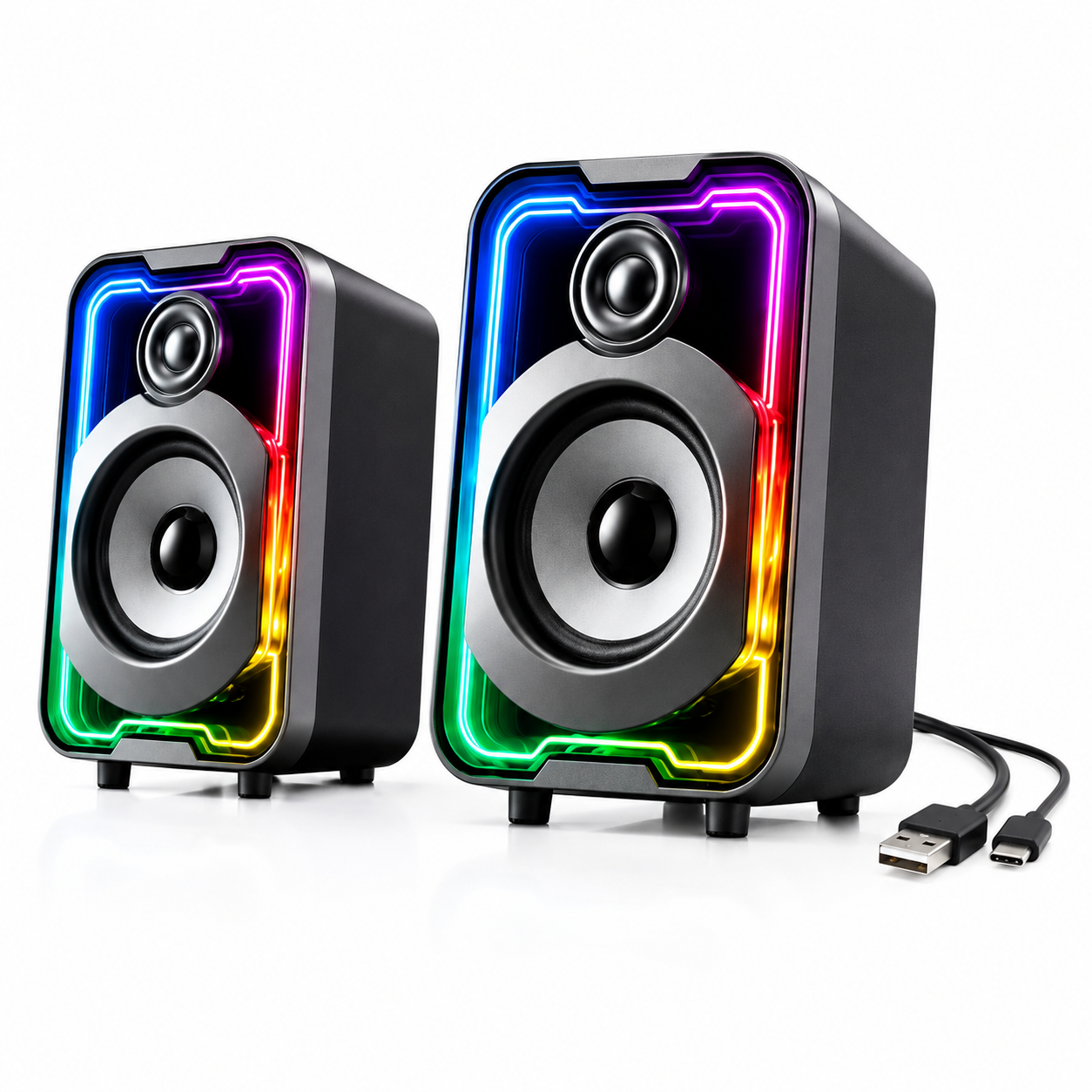
Gaming Soundbar vs 2.0 Gaming Speakers
For many brands, this is the most relevant comparison.
Soundbar Advantages
Compact
Integrated
Easy packaging concept
Strong visual identity
Excellent RGB design opportunities
2.0 Speaker Advantages
Flexible stereo separation
Larger individual enclosures
Traditional gaming appearance
More freedom in acoustic architecture
Both can be successful gaming products when positioned correctly.
Gaming Soundbar vs 2.1 Gaming Speakers
A 2.1 system adds a dedicated subwoofer.
This provides stronger low-frequency potential but also creates:
More cables
Larger packaging
More desk or floor space
More components
A gaming soundbar is generally more suitable for customers prioritizing simplicity and compactness.
A 2.1 system is better suited to customers prioritizing powerful bass.
Which Product Is Better for Gaming Brands?
From an OEM product-development perspective, the answer depends on the brand portfolio.
Choose a Gaming Soundbar If Your Brand Focuses On:
Compact PC accessories
Minimalist setups
Gaming laptops
RGB ecosystems
Space-efficient products
Choose Gaming Speakers If Your Brand Focuses On:
Traditional desktop gaming
Strong stereo positioning
Larger audio systems
2.1 configurations
Consider Offering Both If:
Your brand wants to serve multiple gaming segments.
For example:
Entry Series
Compact USB gaming soundbar
Mainstream Series
RGB 2.0 gaming speakers
Performance Series
2.1 gaming speaker system
This creates a more complete gaming audio portfolio.
OEM Development Differences
Although soundbars and gaming speakers share many components, their engineering processes are different.
Gaming Soundbar Engineering Focus
Priorities include:
Slim acoustic chamber
Driver placement
Monitor compatibility
Control accessibility
RGB integration
Cable management
Gaming Speaker Engineering Focus
Priorities include:
Left/right cabinet acoustics
Stereo positioning
Cabinet volume
Driver configuration
Cable connection between speakers
Manufacturers should not simply reuse the same acoustic solution across both categories.
Cost Considerations
Manufacturing cost depends on specifications rather than product category alone.
Important factors include:
Driver configuration
Amplifier
Bluetooth chipset
USB audio solution
RGB system
Housing materials
Product size
Packaging
Order quantity
For this reason, buyers should compare products based on equivalent specifications instead of assuming a soundbar or 2.0 system is automatically cheaper.
🏭 Real Factory Insight
One of the most common product-development mistakes is choosing the enclosure style before defining the user scenario.
Instead of asking:
“Should we make a soundbar or two speakers?”
A better starting question is:
“What kind of gaming setup are we designing for?”
For example, if the target customer uses a compact desk with a large monitor, microphone, keyboard, and other gaming accessories, a soundbar may provide a better overall experience.
If the target customer prioritizes stereo separation and has sufficient desk space, separate speakers may make more sense.
User scenario should drive product architecture—not the other way around.
Buyer Decision Checklist
Before choosing between a gaming soundbar and gaming speakers, consider:
Target gamer
Typical desk size
Monitor configuration
Desired stereo performance
Bass requirements
RGB requirements
USB audio requirements
Bluetooth requirements
Target retail price
Packaging size
Sales channel
For OEM buyers, answering these questions before requesting quotations can make supplier discussions much more efficient.
Why Choose Shinedee
Shenzhen Shinedee Electronics develops gaming and desktop audio products for global brands.
Our capabilities include:
Gaming soundbar development
2.0 gaming speaker development
RGB lighting customization
Acoustic tuning
Bluetooth integration
USB audio solutions
Industrial design support
OEM and ODM manufacturing
Quality control
Mass production
Our product categories include:
Gaming Soundbars
RGB Gaming Speakers
Desktop Speakers
Portable Bluetooth Speakers
Outdoor Waterproof Speakers
With over 15 years of manufacturing experience, Shinedee helps customers choose and develop audio solutions based on their target users, market positioning, and product strategy.
Frequently Asked Questions
Is a gaming soundbar better than gaming speakers?
Neither is universally better. Gaming soundbars are excellent for compact and clean desktop setups, while separate gaming speakers provide more flexibility for stereo positioning.
Are gaming soundbars good for PC gaming?
Yes. A properly designed gaming soundbar can provide convenient desktop audio while using less space than separate speakers.
Do gaming speakers have better stereo sound?
Separate speakers can be positioned farther apart, giving them an advantage in physical stereo separation. Actual sound quality still depends on product design and tuning.
Can gaming soundbars have strong bass?
Yes, but enclosure size creates engineering constraints. Passive radiators, acoustic design, DSP tuning, and other solutions can improve bass performance.
Is USB audio better for gaming?
USB audio can be convenient for PC gaming because it allows digital audio connectivity through the computer. The best interface depends on the user's devices and product design.
Can a gaming brand customize both soundbars and speakers?
Yes. OEM and ODM manufacturers can support customization of industrial design, acoustics, RGB lighting, connectivity, branding, and packaging.
Which is better for a small gaming desk?
A gaming soundbar is often the more space-efficient choice because it can fit underneath the monitor.
Conclusion
Gaming soundbars and traditional gaming speakers solve different desktop audio needs.
A gaming soundbar is particularly attractive for users who value:
Compact design
Easy installation
Clean cable management
RGB integration
Space efficiency
Separate gaming speakers are attractive for users who prioritize:
Flexible stereo positioning
Larger acoustic enclosures
Stronger expansion possibilities
Traditional desktop audio layouts
For gaming brands, the best product is therefore not determined by form factor alone.
It depends on the target user, desk environment, price positioning, acoustic goals, and overall gaming ecosystem.
Shinedee supports global brands with OEM and ODM development for both gaming soundbars and gaming speaker systems—from product concept and acoustic engineering to testing and mass production.