Gaming Speaker Certifications: Complete Compliance Guide for Global Markets
Gaming Speaker Certifications: Complete Compliance Guide for Global Markets
Introduction
Launching a gaming speaker into international markets requires more than attractive design and excellent sound quality.
Brands must also ensure that their products comply with the regulations of the countries where they will be sold.
Missing or incorrect certifications can lead to:
Customs delays
Product recalls
Marketplace restrictions
Financial penalties
Damage to brand reputation
Whether you are developing an OEM gaming speaker or purchasing a private label product, understanding certification requirements is an essential part of product planning.
This guide explains the most common certifications and compliance standards for gaming speakers sold worldwide.
Why Certifications Matter
Product certifications help demonstrate that a gaming speaker meets applicable safety, environmental, and electromagnetic compatibility requirements.
For manufacturers and brands, compliance helps:
Enter international markets
Reduce legal risks
Improve customer confidence
Simplify customs clearance
Meet retailer requirements
Large retailers and e-commerce platforms often request supporting compliance documentation before listing products.
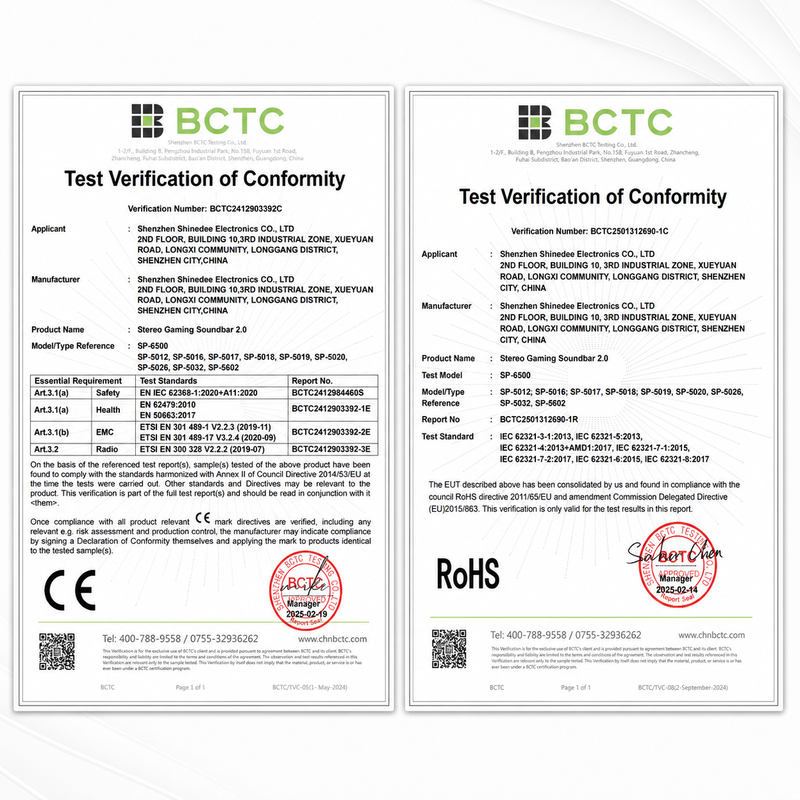
CE Marking (European Union)
The CE marking indicates that a product complies with relevant European regulations.
For gaming speakers, CE compliance may involve requirements related to:
Electrical safety
Electromagnetic compatibility (EMC)
Radio equipment (for Bluetooth models)
The exact directives and standards depend on the product's functions and design.
FCC Certification (United States)
Gaming speakers with wireless communication typically need to comply with FCC requirements before entering the U.S. market.
FCC focuses primarily on:
Radio frequency emissions
Electromagnetic interference
Wireless communication performance
Bluetooth-enabled gaming speakers generally require FCC compliance before commercial distribution.
RoHS Compliance
RoHS restricts the use of certain hazardous substances in electrical and electronic products.
It helps reduce environmental impact by limiting materials such as:
Lead
Mercury
Cadmium
Certain flame retardants
RoHS compliance is widely requested by customers in Europe and many other regions.
UKCA Marking (United Kingdom)
Following Brexit, many products sold in Great Britain require the UKCA marking instead of, or in addition to, CE depending on current regulatory arrangements.
Manufacturers exporting to the UK should confirm the latest requirements before shipment.
REACH Compliance
REACH regulates chemical substances used in products sold within the European market.
For gaming speakers, REACH may involve evaluating materials such as:
Plastics
Coatings
Adhesives
Packaging materials
Working with compliant material suppliers helps simplify this process.
WEEE Requirements
The Waste Electrical and Electronic Equipment (WEEE) framework supports responsible recycling of electronic products.
Brands selling gaming speakers in Europe may need to:
Register with local authorities where applicable
Support recycling programs
Apply appropriate product markings
Responsibilities vary by country.
Battery Regulations
Portable gaming speakers with rechargeable batteries are subject to additional requirements.
Important considerations include:
Battery safety
Transportation regulations
Product labeling
Environmental compliance
Lithium battery transportation rules should be considered during international shipping.
Packaging and Labeling Compliance
Besides product certifications, proper packaging is also important.
Labels may include:
Model number
Power specifications
Manufacturer information
Country of origin
Compliance marks
Disposal symbols
Clear labeling improves customs processing and customer confidence.
Documentation Buyers Should Request
When working with an OEM manufacturer, buyers may request documentation such as:
Product test reports
Compliance declarations
Material information
Inspection reports
User manuals
Product specifications
Having complete documentation helps streamline certification reviews and import procedures.
Common Certification Mistakes
Some common issues include:
Assuming one certification covers every market
Using outdated test reports
Applying incorrect product labels
Ignoring packaging requirements
Failing to verify changes in regulations
Compliance should be reviewed before each new market launch.
🏭 Real Factory Insight
Certification is often viewed as the final step before shipment, but experienced manufacturers consider compliance from the beginning of product development.
Component selection, PCB design, housing materials, firmware, and labeling all influence the certification process.
Planning early helps reduce redesign costs and avoids delays later in production.
How Shinedee Supports Compliance
Shenzhen Shinedee Electronics understands the certification requirements commonly requested by international customers.
We support OEM and ODM projects through:
Product engineering
Compliance-oriented design
Documentation preparation
Quality management
Production consistency
Our product range includes:
RGB Gaming Speakers
Gaming Soundbars
Desktop Speakers
Portable Bluetooth Speakers
Outdoor Bluetooth Speakers
By considering compliance during development, we help customers prepare products for international markets more efficiently.
Frequently Asked Questions
Does every gaming speaker require the same certifications?
No. Certification requirements depend on the product's functions and the destination market.
Does Bluetooth affect certification requirements?
Yes. Wireless communication often introduces additional regulatory requirements.
Can an OEM manufacturer assist with certification preparation?
Yes. Experienced manufacturers can support documentation, testing coordination, and compliance-oriented product design.
Are certifications permanent?
Not always. Product changes, regulatory updates, or design modifications may require additional evaluation.
Why should compliance be considered early?
Early planning reduces development delays, lowers costs, and improves project efficiency.
Conclusion
Certifications are an essential part of bringing gaming speakers to global markets. Understanding compliance requirements early in the product development process helps brands reduce risk, accelerate market entry, and build customer confidence.
By partnering with an experienced OEM manufacturer, brands can better navigate certification requirements while focusing on innovation and business growth. Shinedee is committed to supporting global customers with compliant, reliable, and market-ready gaming audio solutions.
🔎Read more: Gaming Speakers Manufacturer for OEM, ODM and Private Label Brands